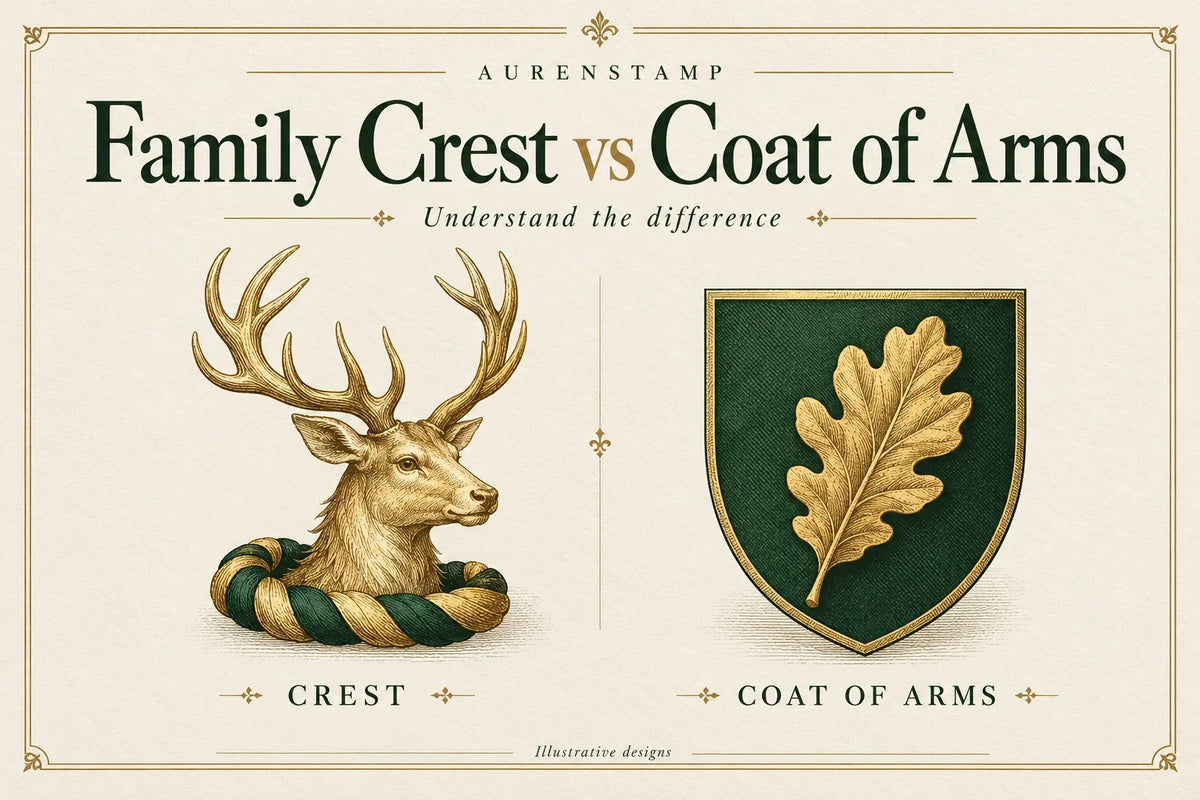
A family crest is the emblem traditionally displayed above a helmet; a coat of arms is centered on the heraldic design on a shield. They can appear together, but they are different parts of a larger display called a heraldic achievement.
The confusion is understandable. On gifts, genealogy websites, and wedding stationery, “family crest” often means the entire design. In heraldry, however, identifying the correct part helps you describe an inherited image, research its history, or prepare artwork for a wax seal.
This guide explains what to look for, why a matching surname is not proof of ownership, and how to choose a design that remains clear in wax.
Family Crest vs Coat of Arms at a Glance
| Question | Crest | Coat of arms |
|---|---|---|
| What identifies it? | A device traditionally above the helmet | The heraldic design on the shield |
| What might it show? | A stag's head, bird, arm, or another figure | Colors, divisions, and figures arranged on a shield |
| Is it the whole display? | No | The term is also used more broadly for the complete display |
| Can it appear by itself? | Yes, where appropriate | Yes; the shield can be shown on its own |
| What matters for a wax seal? | A recognizable silhouette | Clear divisions and enough space between details |
Heraldry is the broader subject: the traditions, description, design, and use of arms. A crest is one element within that subject, not an alternative name for heraldry.
What Is a Family Crest?
A crest is the figure above the helmet in a heraldic display. It often rests on a twisted fabric wreath called a torse. A crest might be a complete animal, an animal's head, a human arm, or an object.
The key is its position and role. A stag's head on a shield is a figure within the arms. A stag's head above the helmet can be the crest. The animal alone does not determine which term applies. The Heraldry Society's terminology FAQ makes this distinction between the crest and the whole display.
The familiar phrase “family crest” survives because it is useful everyday shorthand. If you are ordering stationery, a maker may understand what you mean. If you are asking an archive to identify an image, more precise language is helpful: describe the shield, the device above it, and any inscription separately.

Position matters: the stag is shown as a crest, while the oak leaf is a charge on the shield. These are illustrative designs, not authenticated ancestral arms.
What Is a Coat of Arms?
A coat of arms is a distinctive heraldic design centered on a shield. Its identity depends on the combination of background, colors, figures, and their arrangement—not simply on having a shield-shaped outline.
Three terms help when looking closely:
- Field: the background of the shield.
- Charge: a figure placed on it, such as a leaf, bird, or star.
- Tinctures: heraldic colors, metals, and furs. Gold and silver are traditionally called Or and Argent.
In our illustration, the green background is the field and the gold oak leaf is the charge. The drawing is an educational example, not evidence that a particular surname owns that design.
What Is a Heraldic Achievement?
The larger arrangement around the shield is called an achievement of arms. It may include a helmet, crest, torse, mantling, motto, and, in some cases, supporters beside the shield. These features are not a checklist that every coat of arms must complete. Traditions and entitlements differ. The Heraldry Society's overview of coats of arms illustrates this broader composition.

An illustrated achievement showing six common components. Supporters are not included, and the motto scroll is intentionally blank.
How to Tell What You Are Looking At
An old engraving can be difficult to interpret, especially when decorative flourishes overlap. Start with the structure before trying to decode individual symbols.
- Find the shield. Note its divisions and every figure inside it.
- Look above it for a helmet. Then identify any separate device above the helmet.
- Separate decoration from identifying elements. Flowing cloth around the helmet is mantling; it is not another animal or charge.
- Record any wording exactly. A motto, surname, date, or caption can provide a research clue, but each needs context.
Imagine finding an engraving with an oak leaf on the shield and a stag's head above the helmet. Describing it as “a stag coat of arms” would miss the most useful distinction. A clearer description is “a shield bearing an oak leaf, with a stag-head crest.”
Photograph the complete object as well as the emblem. A bookplate, silver hallmark, handwritten dedication, or document date may tell you more about the original owner than a cropped image does.
Does Everyone With the Same Surname Share the Same Arms?
No. A surname match is a lead, not proof that the arms belong to your branch of a family. The College of Arms explains that arms relate to particular individuals and families rather than surnames as a whole. Its resources page explains why it does not offer a simple surname-based online database.
For example, finding an illustrated “Williams coat of arms” does not establish a connection between its original bearer and every modern Williams household. The missing piece is the documented relationship.

Family-history research starts with records and relationships. This scene is a conceptual illustration, not an archival source.
A More Useful Research Starting Point
Work backward from what you can document:
- Record known relatives, dates, and places before searching for heraldic images.
- Connect generations through reliable records rather than a shared spelling alone.
- Note where an inherited emblem came from and who used it.
- Compare that lineage with relevant heraldic records or seek help from the appropriate authority or specialist.
Keep two questions separate: “Whose arms are these?” and “How, if at all, am I connected to that person?” An image search might help with the first. It rarely settles the second.
Inheritance and recognition vary between countries. A rule encountered in English heraldry should not automatically be treated as universal.
Can You Create Your Own Family Emblem?
For a personal design project, you can develop a new decorative emblem around your own story. Describe it honestly as a modern creation rather than presenting it as an inherited historical coat of arms.
Formal heraldic status is a separate question. Practices vary: for example, the American Heraldry Society's primer explains the American tradition of assuming arms. A decorative design, a privately recorded design, and arms granted by an official authority are not interchangeable categories.
For an original stationery emblem, begin with a short design brief:
“We want a simple mark for letters and anniversary gifts. An oak leaf recalls the tree outside our first home. The design should work without a surname or motto.”
That brief gives the artwork a specific purpose. It is more useful than asking a designer to combine every animal, landmark, and family initial into one small shield.
Also distinguish personal meaning from historical evidence. You can choose an oak leaf to represent a shared memory. That does not establish that every oak leaf in historical heraldry carries the same meaning.
Which Design Works Best for a Wax Seal?
Choose according to the image you need to preserve and the surface where it will appear.
| Your project | A useful design direction | What to check |
|---|---|---|
| Small personal correspondence | An appropriate standalone crest or simple original emblem | Does its outline read clearly? |
| A heritage keepsake | Documented arms or crest | Are the identifying features preserved? |
| Wedding or anniversary stationery | A newly designed personal emblem | Does it feel meaningful without excessive ornament? |
| A detailed heraldic illustration | A larger composition or a carefully chosen component | Will small figures and lettering remain distinct? |
A crest is not automatically simple. Antlers, feathers, and fingers can be as demanding as shield divisions. Conversely, a shield with one bold charge may reproduce more clearly than an elaborate crest.
The Family Crest Wax Seal Design Guide can help you compare compositions before choosing a stamp.
Simplify Rendering Without Changing Identity
There is a difference between reducing decorative detail and changing the design itself.
In the oak-leaf example below, a cleaner outline and fewer fine veins make the image easier to read. The leaf remains the same central subject. If you are reproducing documented arms, casually deleting a charge, changing an animal's pose, or removing a shield division may change what you are representing.

Simplification study: reduce fine shading and surrounding ornament while keeping the central shield and oak-leaf motif.
Use these practical checks when reviewing artwork:
- View it at the intended physical size. Print it at scale; a large screen preview can conceal crowded detail.
- Check the gaps. Antlers, leaf edges, and letters need enough open space to stay distinguishable.
- Review the design in one color. A single-color wax impression cannot reproduce the original painted palette in the same way.
- Inspect wording separately. If a motto becomes too small, consider more space or an appropriate alternative display before changing it.
- Retain a reference copy. Compare the proposed engraving artwork with the original so changes are deliberate.
Use the wax seal stamp size guide to compare dimensions and the artwork preparation guide to prepare a clear file. Treat size as a design decision, not a guarantee that every detail will reproduce.
Bring Your Emblem to Personal Stationery
A seal turns an emblem into something you can use: a mark on a letter, a finishing detail on a gift, or a motif repeated across a family celebration.

AI-generated stationery concept showing an illustrative emblem; not a photograph of a finished AurenStamp order.
If your artwork is ready, explore AurenStamp's custom family crest wax seal stamp. For other design directions, browse the wax seal stamp collection.
Before submitting a file, write down what must remain: the central figure, its orientation, any shield divisions, and essential lettering. That short note helps keep the finished design connected to your original intention.
Frequently Asked Questions
Is a family crest the same as a coat of arms?
Technically, no. The crest is the device traditionally above the helmet; the arms are centered on the shield. Everyday usage often calls the complete emblem a “family crest.”
Can a coat of arms appear without a crest?
Yes. A shield can be displayed independently. A full arrangement with a helmet and crest is not required for every depiction.
Does a surname website prove that a coat of arms is mine?
No. It may identify arms associated with someone who shares your surname, but it does not establish your descent from that person or the applicable rules of inheritance.
Can I use only the crest on a wax seal?
A standalone crest can be a suitable choice where appropriate to the tradition and your use of the design. Check the artwork at the proposed size; a compact composition can still contain intricate detail.
Is an AI-generated family emblem historically authentic?
Generating an image does not authenticate ancestry, establish hereditary rights, or obtain an official grant. AI can help explore a modern design, but historical claims require independent evidence.
Should I choose a crest or a shield for my seal?
Choose the component that best serves your purpose and remains recognizable at the final size. For an inherited design, preserve its identifying features. For a new emblem, start with one meaningful focal point and build only as much detail as the seal can comfortably hold.
Teilen:
Kann man Briefumschläge mit Wachssiegeln verschicken?
Family Crest Symbols and Meanings: A Guide to Heraldry