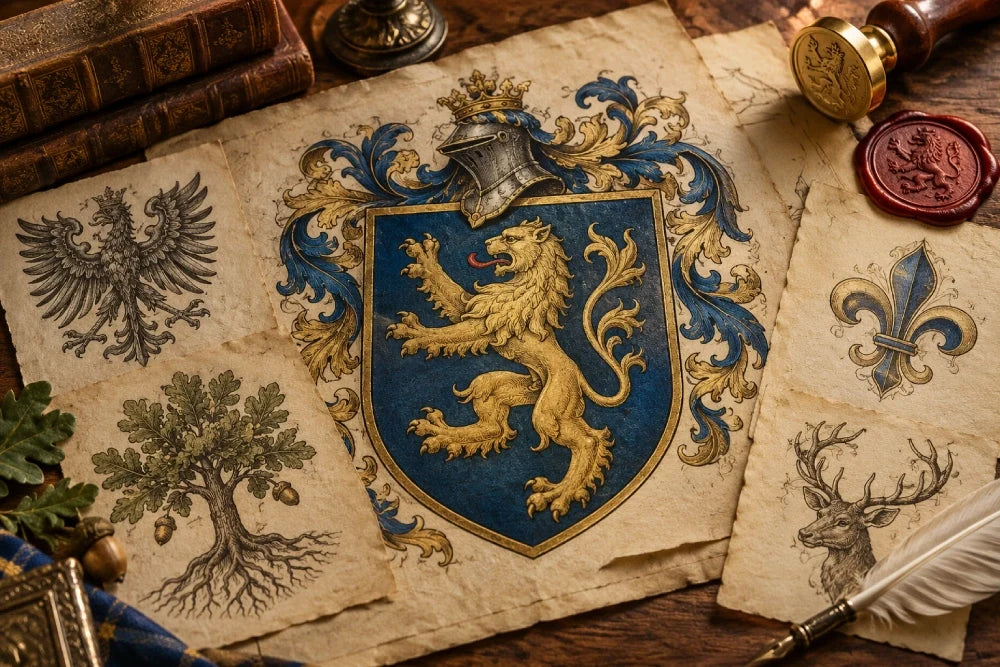
A family crest can tell a story without using a single word. A lion standing on its hind legs, an oak tree with exposed roots, or a pair of crossed keys may look like decorative details at first. In heraldry, however, these elements can reveal connections to a person's ancestry, occupation, homeland, or individual achievements.
Understanding family crest symbols and meanings begins with a simple question: why was a particular symbol chosen?
The answer is not always what a symbolism chart suggests. A lion does not automatically mean bravery, and a blue shield does not necessarily represent loyalty. Historical heraldry is more personal—and often more interesting—than that.
This guide explores common heraldic animals, plants, colors, and objects, explains how their meanings are interpreted, and shows how these traditional designs can inspire modern family emblems.

What Do Family Crest Symbols Actually Mean?
In heraldry, symbols help distinguish one coat of arms from another. They may represent historical events, geographic connections, occupations, personal values, or references to a person's name.
The figures displayed on a heraldic shield are called charges. Common charges include animals, flowers, trees, stars, crosses, and everyday objects.
Although people often use "family crest" to describe an entire heraldic emblem, the terms crest and coat of arms have different technical meanings.
A crest traditionally appears above a helmet, while the coat of arms refers primarily to the design displayed on a shield.
If you're researching an inherited emblem, our guide to family crest vs coat of arms explains this distinction in more detail.
Do Heraldic Symbols Have Universal Meanings?
Not necessarily.
Many popular guides associate lions with courage, eagles with power, and oak trees with endurance. These interpretations can be useful starting points, but they are not fixed historical rules.
A symbol might have been selected because it resembled someone's surname, represented a hometown, or commemorated an important event.
For this reason, an authentic interpretation should begin with the history of the particular coat of arms rather than a generalized list of symbolic meanings.
Common Animal Symbols in Family Crests
Animals have appeared in heraldry for centuries. Their recognizable shapes make them particularly effective as identifying devices.
| Animal | Common Associations | Important Consideration |
|---|---|---|
| Lion | Courage, strength, authority | Its actual significance depends on the arms |
| Eagle | Power, sovereignty, leadership | Often associated with historical political traditions |
| Stag | Nature, endurance, nobility | May reference hunting, geography, or a surname |
| Boar | Determination, resilience | Can represent a specific family or regional connection |
| Griffin | Strength, vigilance, protection | A mythical creature combining eagle and lion |
| Horse | Movement, freedom, strength | May refer to occupation, place, or personal identity |
| Wolf | Loyalty, courage, persistence | Interpretations vary considerably |
These associations are descriptive possibilities, not universal definitions.
Lions: Strength and Authority
The lion is one of the most recognizable animals in European heraldry.
Its use in royal and noble arms helped establish strong associations with authority, courage, and military strength.
A lion may be shown rampant, standing upright on its hind legs, or passant, walking with one forepaw raised.
These terms describe its heraldic position rather than assigning separate personality traits.
When studying an old family emblem, examine the lion's position, number, color, and surrounding elements. These details help identify the design more accurately than the animal alone.
Eagles: Power and Historical Identity
Eagles appear throughout European heraldic history, including the arms of imperial and royal institutions.
An eagle with its wings spread is described as displayed.
Although eagles are frequently associated with power and sovereignty, their significance varies with the person or institution using them.
For a modern family emblem, an eagle's broad silhouette creates a recognizable central feature. Its individual feathers, however, may need simplification if the artwork will eventually become a small wax seal.
Stags, Boars, and Other Animals
A stag might suggest a connection with nature or hunting traditions. A boar may evoke determination and resilience.
Yet both animals could also represent geographical locations or family names.
This is why two families using the same animal may have entirely different stories behind their emblems.
When choosing an animal for a new design, consider whether it reflects something genuinely meaningful rather than selecting it solely for its traditional associations.

Plants and Flowers in Family Crest Designs
Botanical symbols offer a different visual character from animals. They can feel quieter, more personal, and closely connected to places or family traditions.
Oak Trees: A Symbol with Many Possible Stories
Oak trees are commonly associated with endurance, longevity, and strength.
Their branches, leaves, acorns, and roots also provide opportunities for more specific symbolism.
For example, an oak tree could represent a family's connection to a woodland landscape.
Its acorns might be used to symbolize future generations—but only if that meaning was deliberately intended.
In historical heraldry, the oak might instead refer directly to a person's surname.
We will examine a documented example of this later in the article.
Roses and Floral Emblems
Roses are particularly recognizable in English heraldic history.
The red and white roses associated with the Houses of Lancaster and York are familiar examples of how a flower can become connected to a particular historical identity.
However, not every red rose indicates Lancastrian ancestry, just as not every white rose establishes a connection with York.
Flowers may also be chosen for religious, geographical, personal, or decorative reasons.
The Fleur-de-Lis
The fleur-de-lis is a stylized floral emblem strongly associated with French royal heraldry.
It also appears in regional, religious, and institutional designs.
Its clean, balanced shape makes it particularly recognizable.
For modern decorative artwork, the fleur-de-lis can suggest a traditional European style without requiring an elaborate composition.
Nevertheless, its appearance alone should not be treated as proof of French royal ancestry.

Other Common Heraldic Symbols and Their Uses
Animals and plants are only part of the visual language of heraldry.
Objects and geometric shapes can be equally distinctive.
| Symbol | Historical or Common Associations |
|---|---|
| Cross | Religious connections and regional traditions |
| Sword | Military identity, authority, or historical events |
| Anchor | Maritime occupations, ports, and connections to the sea |
| Key | Authority, responsibility, or specific religious associations |
| Escallop shell | Pilgrimage, particularly the tradition of St. James |
| Chevron | A common heraldic geometric form |
| Crescent | A decorative charge or a mark of difference in certain traditions |
| Star | Personal, geographical, or heraldic identification |
Consider an anchor.
A symbolism website might describe it as representing hope or stability. But on an actual coat of arms, an anchor could simply indicate that the person worked in shipping or came from a port city.
The most valuable interpretation is often the most specific one.
For readers interested in the traditional structure and arrangement of these devices, our article on coat of arms symbols and meanings examines heraldic charges, shield divisions, and terminology in greater detail.

Family Crest Colors and Their Meanings
Color is an essential part of heraldic design.
Traditional heraldry uses a system known as tinctures, including colors and metals.
| Heraldic Name | Color |
|---|---|
| Gules | Red |
| Azure | Blue |
| Vert | Green |
| Sable | Black |
| Purpure | Purple |
| Or | Gold or yellow |
| Argent | Silver or white |
You may encounter claims that red always represents courage, blue always means loyalty, and green always symbolizes hope.
These associations should not be treated as universal heraldic rules.
Colors primarily help establish the identity and visual structure of a coat of arms.
Traditional heraldry also follows conventions intended to maintain contrast. For example, placing a light metal such as Argent against a dark color such as Azure generally makes a design easier to distinguish.
The Canadian Heraldic Authority explains these principles in its official heraldry guidance.
An important practical detail is that historical arms are not necessarily tied to one precise modern color shade. Heraldic red, for instance, can be represented in different recognizable shades of red.
A Real Family Crest Example: The Story Behind an Oak Tree
One of the most revealing examples of personal heraldic symbolism comes from Canada's official heraldic records.
On March 20, 2009, Pierre Duchesne received a grant of arms recorded in the Canadian Public Register of Arms, Flags and Badges.
His coat of arms features an oak tree with exposed roots and acorns.
According to the official explanation:
- The oak tree refers to the surname Duchesne, meaning "of the oak."
- Three visible roots represent his three children.
- Seven acorns represent his grandchildren and future descendants.
- A blue horizontal band refers partly to his connection with the sea.
- A crane in the crest represents L'Isle-aux-Grues, a meaningful location in Quebec.
- A paintbrush held by the crane reflects his interest in the arts.
These details are documented in the official Canadian heraldic register.
What makes this example interesting is how several ordinary objects combine to tell a specific story.
An oak tree does not simply represent strength. Its roots, fruit, and relationship to the surname create a personal meaning.
Similarly, the crane is not merely a generic symbol of vigilance. It refers to a particular place.
The strongest heraldic symbolism often comes from details that are meaningful to the person or family—not from choosing impressive-looking symbols.

How to Identify the Meaning of Your Own Family Crest
If you have an old family emblem, begin with its history rather than immediately interpreting its images.
A practical research process includes four steps.
1. Identify the original source.
Look for family documents, historical illustrations, old seals, genealogy records, or photographs of objects bearing the emblem.
2. Find the heraldic description.
A formal description of a coat of arms is called a blazon. It records the colors, figures, and their arrangement.
3. Research the relevant tradition.
Rules concerning heraldry and inheritance differ between countries.
4. Check the family connection.
Sharing a surname does not automatically establish the right to use a particular historical coat of arms.
An online illustration labeled with your last name may belong to an unrelated family.
If your research does not establish an authentic historical connection, you can still appreciate the design without presenting it as verified family heritage.
How to Choose Symbols for Your Own Family Crest
Not every meaningful family emblem needs to reproduce historical arms.
An original design can be inspired by family traditions, shared experiences, occupations, or important places.
Imagine a family that has lived near the coast for several generations.
Rather than combining a lion, eagle, crown, and elaborate shield simply because those elements look traditional, the family might choose a single anchor framed by waves.
The design would have a clearer connection to its intended meaning.
Another family might choose an oak tree accompanied by a small number of leaves representing family members.
These are hypothetical design examples, not historical coats of arms.
When developing your own emblem, begin with a few questions:
- Which place has particular importance to your family?
- Is there an animal, plant, or object connected to your family's history?
- Would initials make the design more personal?
- Do you prefer a traditional shield or a simpler contemporary emblem?
Try sketching three variations of the same concept.
One might use a central symbol alone. Another could place the symbol inside a shield. A third might combine it with initials.
Compare them at a small size rather than judging only from a large screen.
For a more complete creative process, read How to Create a Family Crest: Symbols, Shields & Design.

From Heraldic Artwork to a Wax Seal
A design that looks excellent on paper does not automatically work as an engraved wax seal.
Historical coats of arms were often created for larger surfaces, where fine feathers, intricate leaves, banners, and small inscriptions remained visible.
A wax seal stamp has considerably less room.
The design needs to be recognizable after its shapes have been transferred into a small impression.
Keep the Most Important Symbol
Consider an oak tree surrounded by numerous tiny leaves.
At a small scale, individual leaves may merge into an indistinct texture.
A more practical adaptation might retain the tree's distinctive trunk, major branches, and a simplified arrangement of foliage.
The goal is not to remove its identity, but to preserve the elements that make it recognizable.
Similarly, an elaborate eagle may benefit from clearer wing shapes and fewer feather lines.
Check the Artwork at Its Actual Size
A useful preparation method is to print the design at the diameter of the intended stamping head.
A crest that looks balanced at 150 mm wide may be difficult to recognize when reduced to 30 mm.
This is especially true when the artwork includes a surname, motto, or several small heraldic charges.
AurenStamp offers round stamp sizes of 25, 30, 35, 40, and 50 mm.
A simple initial or symbol can work at a smaller size, while a complex shield may benefit from 35–50 mm.
However, increasing the size does not automatically solve problems caused by excessively thin lines or crowded details.
Our Wax Seal Stamp Size Guide explains how to compare these dimensions and choose proportions that suit the artwork.
Prepare Clean, Engraving-Friendly Artwork
When converting a family emblem into a stamp design, begin with the clearest original available.
Vector artwork is particularly useful because its lines and shapes remain editable.
A sharp, high-resolution image may also provide a suitable starting point, although it could require cleanup.
Avoid relying on photographic shading or subtle gradients to define important details.
For example, a shield illustrated with shadows and textured metal might need to become a simpler black-and-white design before engraving.
Do not reverse or mirror your original artwork unless the template or production instructions specifically require it.
For detailed preparation advice, see AurenStamp's Wax Seal Stamp Artwork Guide.
Test the Finished Impression
Even a well-prepared engraving depends on proper use.
The amount of sealing wax, its temperature, and how evenly the stamp is pressed can all influence the impression.
An incomplete seal does not always mean the artwork or engraving is defective.
Too little wax may leave gaps, while lifting the stamp before the wax has sufficiently cooled can distort fine details.
A useful starting point for a smaller stamp is three or four average-sized sealing wax beads, adjusting the quantity according to the stamp diameter and the wax itself.
Press the stamp straight down, keep it still, and allow the wax to firm before lifting.
For beginners, our How to Use a Wax Seal Stamp guide explains the process and common problems.
If you're working with an existing historical emblem, the next useful step is learning how to turn a coat of arms into a wax seal stamp, including how to preserve its most recognizable details.
Creating a Custom Family Crest Wax Seal Stamp
A family crest wax seal can be used for personal correspondence, wedding invitations, family celebrations, keepsakes, and meaningful gifts.
You might already have an inherited illustration, an old family document, or a newly created emblem.
Each provides a different starting point.
At AurenStamp, a custom family crest wax seal stamp can be personalized with your own crest, coat of arms, or original family-inspired artwork.
The product is available with several stamping-head sizes and handle styles.
Artwork is reviewed with engraving requirements in mind, particularly when a design includes small lettering, detailed animals, or elaborate shields.
If you're unsure whether your artwork needs adjustment, the Family Crest Wax Seal Design Guide provides examples of suitable compositions, shield styles, and artwork requirements.
A carefully prepared family emblem can become a reusable stamp that brings a consistent personal detail to letters and special occasions.
Frequently Asked Questions
What are the most common family crest symbols?
Lions, eagles, stags, roses, oak trees, crosses, stars, and geometric shapes are common heraldic elements. Their particular meanings depend on the historical context and design.
What does a lion represent on a family crest?
Lions are frequently associated with courage, strength, and authority. However, their appearance does not establish one universal meaning or prove noble ancestry.
What do family crest colors mean?
Heraldic colors help define and distinguish coats of arms. While individual colors may have symbolic associations, their meanings are not universally fixed.
Can I create my own family crest symbols?
Yes. You can create an original decorative emblem using animals, plants, initials, or other meaningful elements. Creating a personal design is different from claiming entitlement to someone else's historical arms.
How do I know whether a family crest is authentic?
Research its original source, formal heraldic description, and documented family connection. A surname match alone is not sufficient evidence.
Can detailed family crest symbols be engraved into a wax seal stamp?
Many can, although intricate artwork may require simplification. Clear outlines, balanced spacing, and an appropriate stamp size help preserve recognizable details.
Final Thoughts
Family crest symbols become more meaningful when we understand the stories behind them.
A lion, oak tree, or fleur-de-lis may have familiar historical associations, but its significance within a particular family emblem is often more personal.
The best way to interpret traditional heraldry is through reliable records and the circumstances surrounding the original design.
For a modern family emblem, the same principle applies: choose symbols that reflect something meaningful, then develop a composition that communicates the idea clearly.
Whether you're researching historical arms or creating an original design for stationery and keepsakes, a thoughtful emblem can carry a story beyond its decorative appearance.
Explore more personalized wax seal ideas at AurenStamp.
Share:
Family Crest vs Coat of Arms: What's the Difference?